

Last Monday, I had a post on X that went viral.
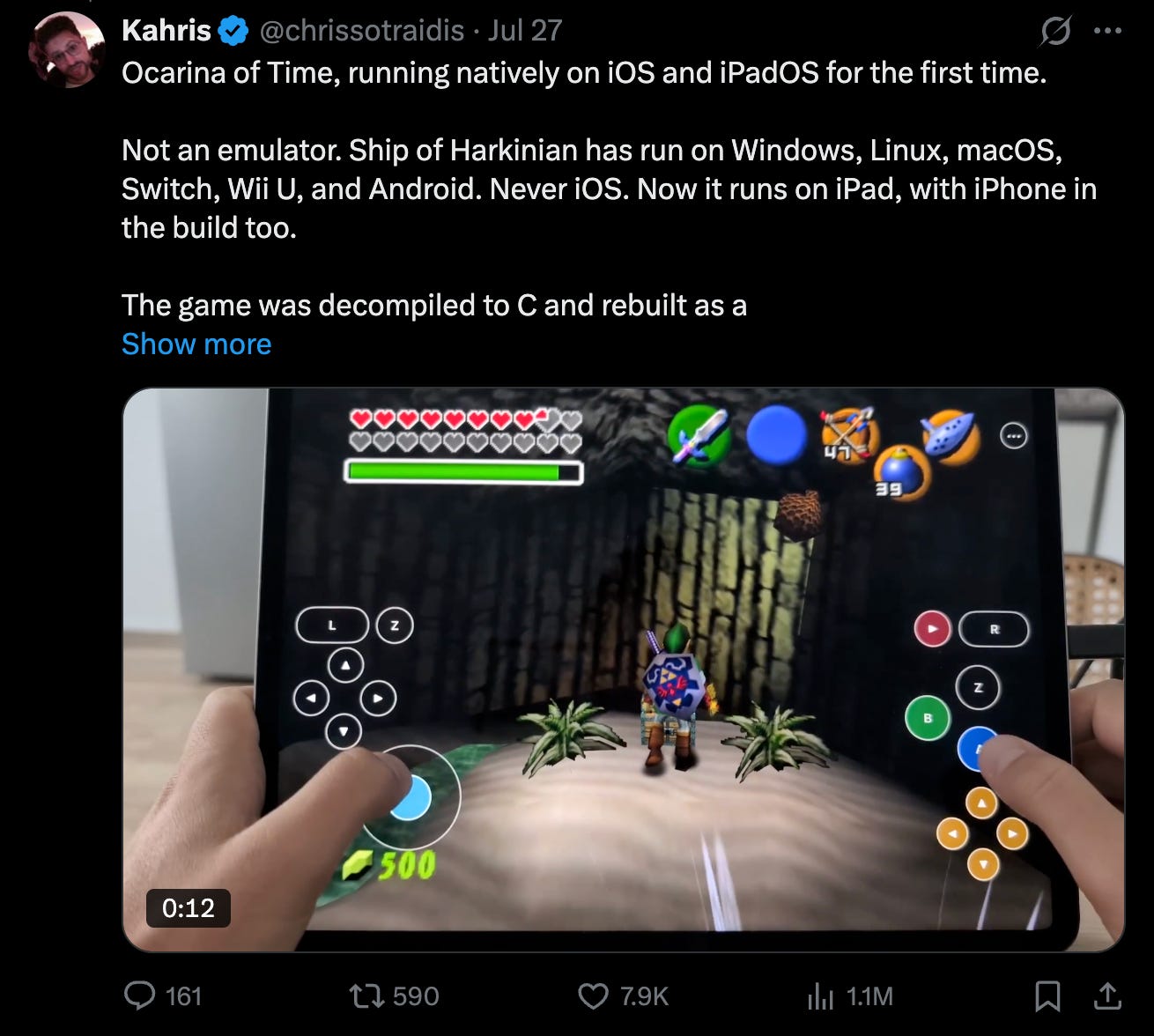
This is the first time I’ve ever had a post do so well, and there’s a reason why. I posted a 30-second video of The Legend of Zelda: Ocarina of Time, running natively on iPad. It received 28 press pieces across 26 outlets in roughly 8 languages between July 27th and the 31st, Tom’s Hardware being one of the bigger ones. The news outlets got a good amount of info wrong, and generalized what I did, and how I did it. I figured this build would receive some attention, but I genuinely could not have predicted how viral it would go.
The decompilation community has been incredibly active this year. For those that are less familiar, decompilation is the reverse engineering process of turning compiled, machine-readable binary code back into a high-level, human-readable programming language like C or Java. Up until recently this was tedious, grueling, and often thankless work.
We’re seeing more projects completed than ever, and AI is part of why. Chris Lewis took the Snowboard Kids 2 decompilation from 25% to 45% in two weeks using Claude, after it had crawled five points in the two months before that, and finished the whole thing in May.
But the hard parts are still human. AI usage in every aspect of gaming development is still incredibly divisive and controversial. Many Discord communities will remove your content or ban you if you share anything that has been touched by genAI. As someone who loves art and design, I get it.
This viral post didn’t just fall out of the sky, though. Here’s how it happened.
Ammaar Reshi’s Post
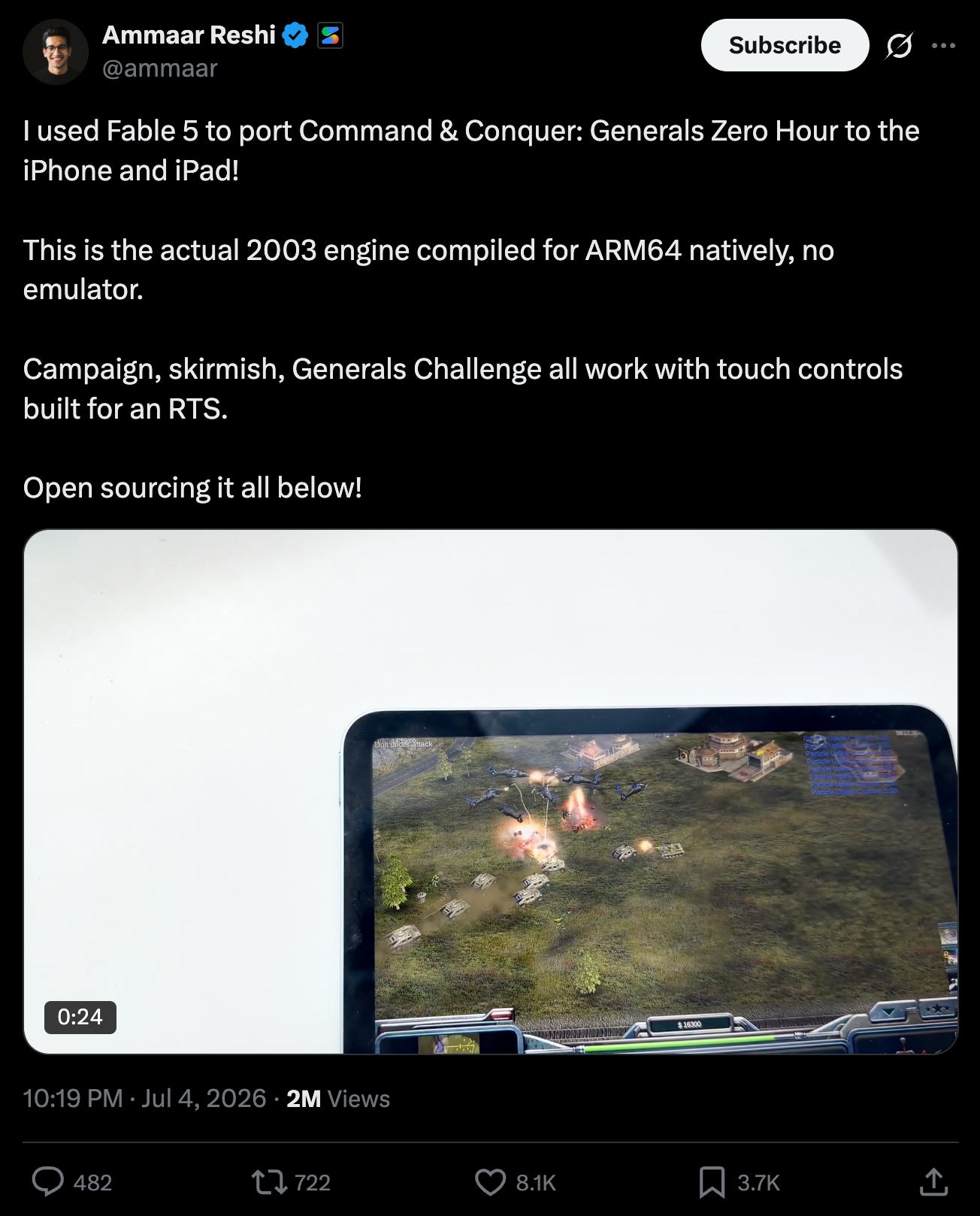
I saw Ammaar Reshi’s post in early July and was blown away. C&C Generals was open-sourced by EA back in February 2025, and all that was missing was the project being compiled for ARM64. Easy to imagine, and previously difficult to do.
Even back in March or April of this year, attempting more ambitious ports like this of games was not something people were really talking about or posting about online. I honestly hadn’t thought about it and didn’t want to exhaust any tokens attempting to do this, and I wasn’t sure if there would be any interest. But Ammaar’s post really had a lightbulb go off in my head. There were countless games with open-source game engines just waiting to be tinkered with. In my opinion, Fable-level agentic tools have enabled this.
I travel with and own an iPad, so it didn’t take long to do some research to find projects that might be a possibility on iPad. The games had to be something people loved, with engines that could be easily adapted and utilized on iOS and iPadOS. They also needed to be games that could be realistically played on a touchscreen. Considering how many games are closed, or have open-source reimplementations that still don’t actually work (openage, the Age of Empires II engine clone, has been in development for years and still isn’t playable end to end), the list is surprisingly small.
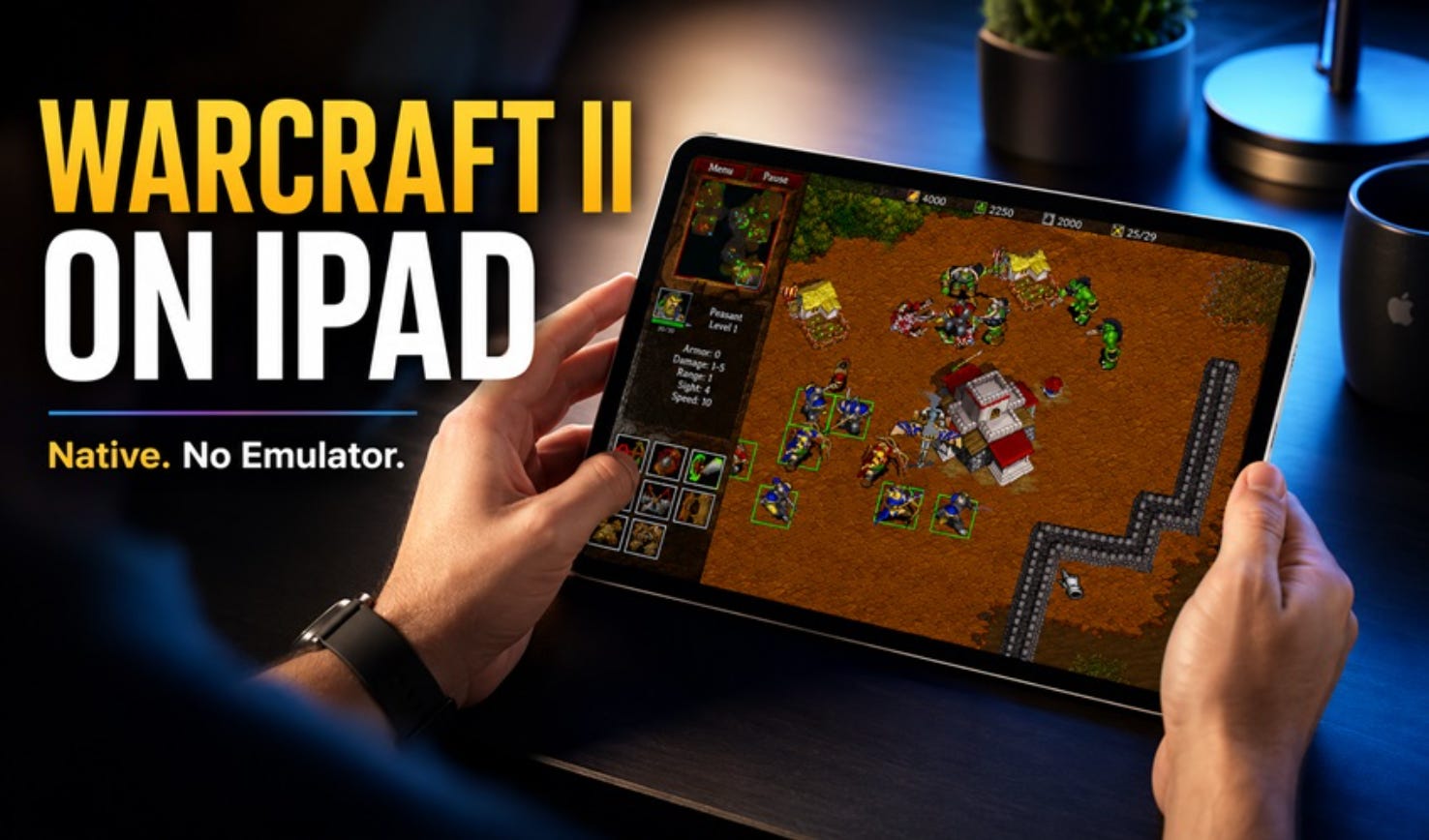
The first game I did was Warcraft II. This also received coverage online and got people talking. It even received the attention of Ammaar, who encouraged me to keep going. It did pretty well online, but I had another game building that I was even more excited about: RollerCoaster Tycoon 2.
This build did even better, and got a quarter million views. A couple days later, I did a touch-adaptation of Diablo, and then Fallout 2. Finally, after getting back from my vacation, completely jet-lagged and exhausted, I posted Zelda.
Zelda on iOS
The iOS Zelda build worked because it was built on top of a ton of previous human-led work. Harbour Masters and the OoT decompilation team spent years on Ship of Harkinian. SoH is a source-available port of Ocarina of Time. All I did was put it on a platform where it had never been native before.
HarkinianPad, my release, required a great deal of research and thoughtfulness to do, but it didn’t take that long. In fact, I was taking a shower while on vacation in Bangkok and thought ‘wait, has anyone ever natively ported Zelda to iPhone?’. Surely it had been done, right?
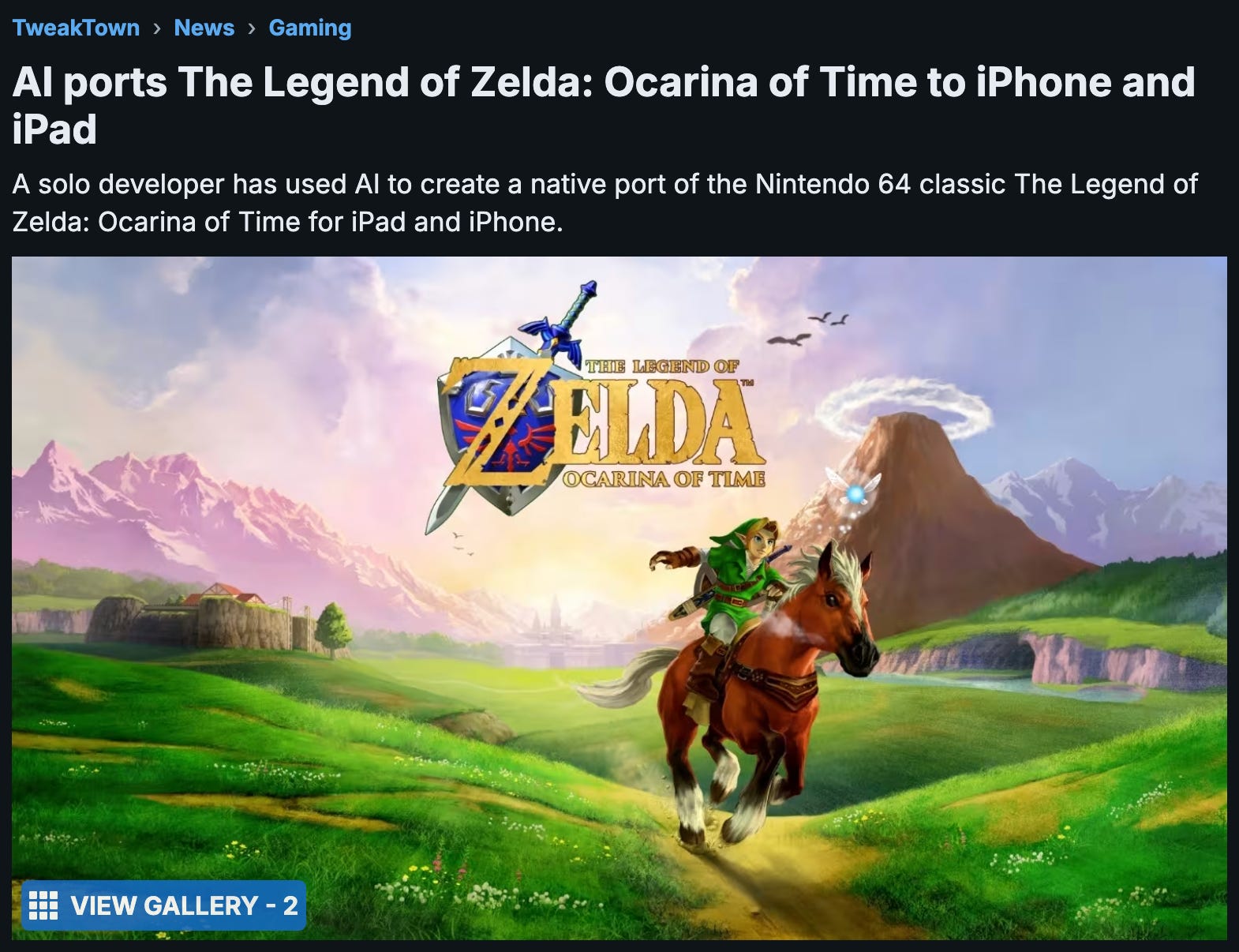
Ocarina of Time had never run natively on iOS. Other decompiled games had made it there, ckosmic put Super Mario 64 on iPhone and Apple TV back in November 2021, but nobody had done Zelda. There was one other GitHub project created a week prior, but it was never posted publicly, and I only found it after my post went viral.
The iOS adaptation is 606 lines across 18 files, and I ended up reusing this adaptation across a few other N64-based projects. Ocarina of Time took a couple days of testing and touch-control refinement. By the time I did the iOS version of Mario Kart, the process had refined substantially, and the numbers show it. Zelda took nine patches and about 4,500 lines of changes over a few days. Star Fox took four patches and 3,500 lines over three days. Mario Kart took 2,175 lines and a single day. Majora’s Mask, three days. Each one cost less than the last.
Where This is Heading
So, where am I going with this? Am I just going to do ports of games forever? No.
In the last 3 weeks, I’ve posted 12 builds. In the last week, I’ve been posting new builds almost daily. The pace is increasing as the workflow has gotten more predictable and I know what to look for and do. At any given moment, I have multiple builds testing and using the Simulator within macOS. This heavily relates to an article I wrote last month, entitled The Personal Computer That Never Sleeps. It will become more obvious as the year progresses, but it is clear that having access to more personal computers to run projects that utilize full-computer use is an advantage for ICs, builders, and engineers.
As I’m writing this, I have two upcoming games building on two different macOS machines. I have another computer building personal software I’m creating in my spare time. This leaves my personal machine to do last-mile, local development.
This is leading to attempting increasingly complex software projects. Projects that, under any previous circumstances, I would never attempt or even think about. The barriers for doing complex work are shattering before our eyes, largely because of the fantastic agentic harnesses from top frontier model companies.
Here’s an example.
Crash Team Racing (CTRPad)
Crash Team Racing was decompiled by the CTR-tools community, and the CTR Native project turned that decompilation into a working native build. It only ran on Windows and Linux. Until today.
I started and finished a new project, that I’ve called CTRPad, in about 4 days. CTRPad is not a conventional mobile port. It began with existing native game code, but the Apple work required converting a 32-bit, pointer-heavy runtime for 64-bit ARM, validating that conversion against gameplay traces, and bringing rendering to shared macOS OpenGL and iOS GLES paths. Additionally, it required building Apple-specific layers around it, like lifecycle handling, sandboxed game-data import, touch controls, signing, packaging, and device validation.
Codex built a test harness for the conversion out of necessity. It records a real run, replays it in a different memory layout, and compares the state frame by frame. It also corrupts a vehicle position mid-run on purpose, so I know the test is capable of failing. It still hasn’t passed a full clean run. That’s documented in the repo.
I’ve released CTRPad today, and for the first time ever Crash Team Racing is playable natively on macOS, iOS, and iPadOS. I analyzed the repo after the release, and had Codex attempt to guess how long this would have taken in the past to actually do.
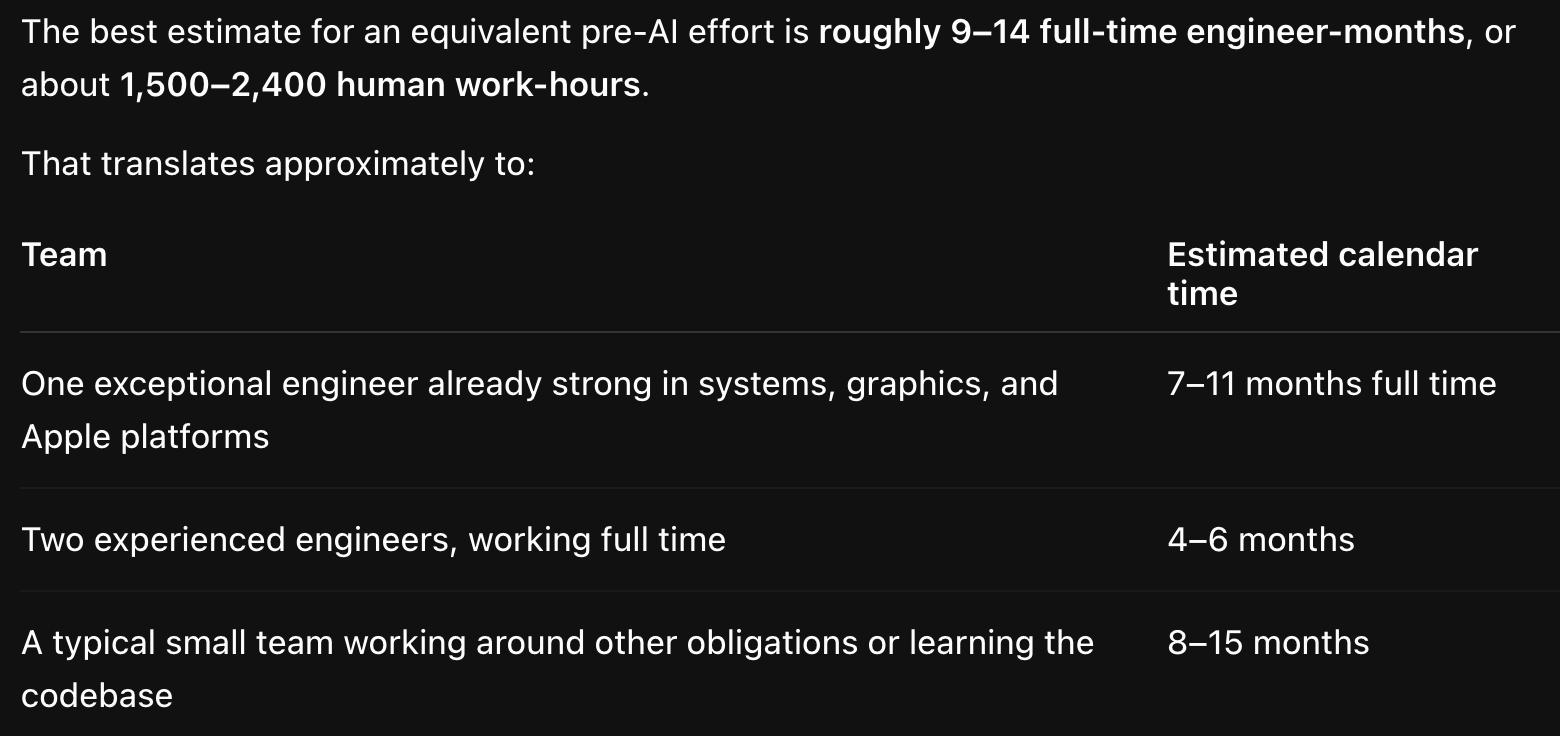
It’s entirely possible this estimate is wrong. It’s possible there’s a wunderkind out there that could have done this without AI in a few weeks. But this is the estimate. The work done for CTRPad would have, conservatively, taken someone about a year of development time if that was their full-time job. Again, this build was completed and refined within just a few days. Codex ran nonstop for 3 days and 11 hours, and I spent hours refining the controls and fixing bugs. This estimate assumes the native CTR codebase already exists.
Feel free to download it and try it out. It looks and plays fantastic.
The Future of Software
My eyes have been opened even more this summer after building some of these projects the last few weeks. It has completely changed how I think about development, and what one person is capable of producing or delivering. Make no mistake, things are speeding up fast.
I have more ambitious projects coming. The thing that surprised me most about the last three weeks is how little of it was code. Most of my time went into deciding exactly what I wanted and writing tests that could tell me when I hadn’t gotten it.
A few weeks ago I saw someone’s post and got curious. Since then I’ve shipped twelve builds. The distance between those two things used to be much longer.
Thanks for reading.
- Chris