

7:42 A.M. Tuesday

Sarah opens her laptop at a cafe in Denver. She’s the head of sales at a SaaS company; or, rather, she is the sales team. Her morning doesn’t begin with checking emails. It begins with reviewing what her agents accomplished overnight.
The dashboard loads, and three qualified leads move to warm status based on conversations Sarah’s AIs had with prospects in Europe while she was sleeping. One deal that had been stalling for two months is suddenly moving: an agent noticed a job posting from the prospect’s company indicating they’d just raised a Series B, automatically re-prioritizing the account, and sending a congratulatory message that prompted a response. The prospect wants to hop on a call this afternoon.
Sarah’s calendar has already been optimized. A meeting she had scheduled with a window shopper has been deprioritized, with the new hot lead sitting in the 2PM slot. Sarah’s agent didn’t just suggest this, it already emailed both parties, confirmed availability, and rescheduled the meetings. Sarah’s morning summary reads like a briefing from a highly intelligent assistant: “4 active opportunities progressed. 2 new inbound qualified. 1 contract out for signature. Recommended focus: the Acme deal needs a personal touch, their CFO raised a concern about implementation timelines in yesterday’s thread.”
Sarah sips her coffee. By 8 AM, she’s already reviewing a contract draft one of her agents created based on previous deals with similar company profiles. She takes a look briefly, but thinks it looks fine. Her afternoon meeting isn’t even with the prospect directly, it’s with the prospects procurement AI, an agent that handles vendor evaluations. She’ll still need to be sharp for the meeting, but all the heavy lifting of research, personalization, and follow-up has already been handled.
Although this may sound somewhat far off, many teams in early 2026 are already operating like this. The tools enabling this kind of workflow are proliferating faster than most companies can keep up. Sarah’s morning is increasingly normal for lean teams in 2026. And the companies building these workflows are rewriting the economics of business.
The Smallest Companies Move the Fastest
The internet transformed business forever, but AI is reshaping work even more radically. Cursor, the AI-powered code editor, reached a $9B+ valuation in 2025 with ~40 employees. The revenue per employee of a company like Cursor is an order of magnitude higher than the traditional SaaS benchmark of ~$150-250k per employee. Cursor hit $100M ARR in 12 months, the fastest any SaaS company has ever reached that milestone.
But Cursor isn’t an anomaly, it’s part of a pattern.
Similarly, Midjourney generates ~500 million annually with 107 employees. They reached profitability in two months with zero external funding, spent nothing on marketing, and now command roughly a 1/3rd of the global AI image generation market. And, Bolt.new reached $4M ARR in a single month with less than 20 people, kickstarted by a single tweet. Replit grew from $2.8M to $150M in less than a year. The list goes on.
For established companies, the math here is brutal. AI-native startups simply operate differently, at 10-60x the revenue efficiency of traditional organizations. It isn’t because they found a magical sales technique, or learned arcane magic. Nope. It’s because they’ve built their entire operational model around AI from day one. AI isn’t just bolted on. It’s at the center of everything they do, and how they operate.
We’ve seen this trend before.

During the dot-com boom of the 90s, scrappy startups with small teams disrupted industries dominated by gargantuan incumbents. The winners were the ones that understood the medium the best and moved the fastest. Amazon started out in a garage, and Google was just two grad students with a great idea. Companies like IBM and Walmart had virtually unlimited resources by comparison, but lacked a true understanding of the space, and agility.
We are in the same moment now. The companies that will dominate the agentic era will not be the companies with thousands of employees and massive sales teams. They’ll be the companies that figure out how to make a team of 10 operate like a team of 100.
The Vercel Experiment
The company behind next.js, Vercel, wanted to mix things up. Their COO asked a simple question, “What part of your job do you hate doing the most” and “What tasks would you like to never do again?” The answers were pretty predictable. Repetitive stuff, grunt work, tasks that needed to get done, but felt like busywork.
The immediate insight was this: these were tasks that were too dynamic for traditional automation, but perfect for AI. Simplistic scripts couldn’t handle them, but custom-built agents could.
The sales team at Vercel became the test case. Three engineers shadowed their top sales performer for a few weeks. They documented every task, method, and decision point, and then built an agent workflow.
That workflow consisted of:
Deep research on each incoming lead and their company
Categorization and scoring using structured outputs
Auto-generation of personalized follow-up methods
Routing to Slack for human approval before sending
Automatic dispatch upon approval
The result? One person now handles the work that previously required ten. Those 9 other people weren’t laid off, but were redirected to higher-agency, higher-value sales activities where human judgement and relationship-building really matter. AI started handling the volume work, and humans handled nuanced work.
The question isn’t if AI ‘can do this work’. It’s what should humans actually be spending their time on? Increasingly, the answer is work that requires judgement, creativity, relationship-building, and nuanced decision-making that AI cannot replicate and we don’t trust it to perform.
Running AI in Parallel
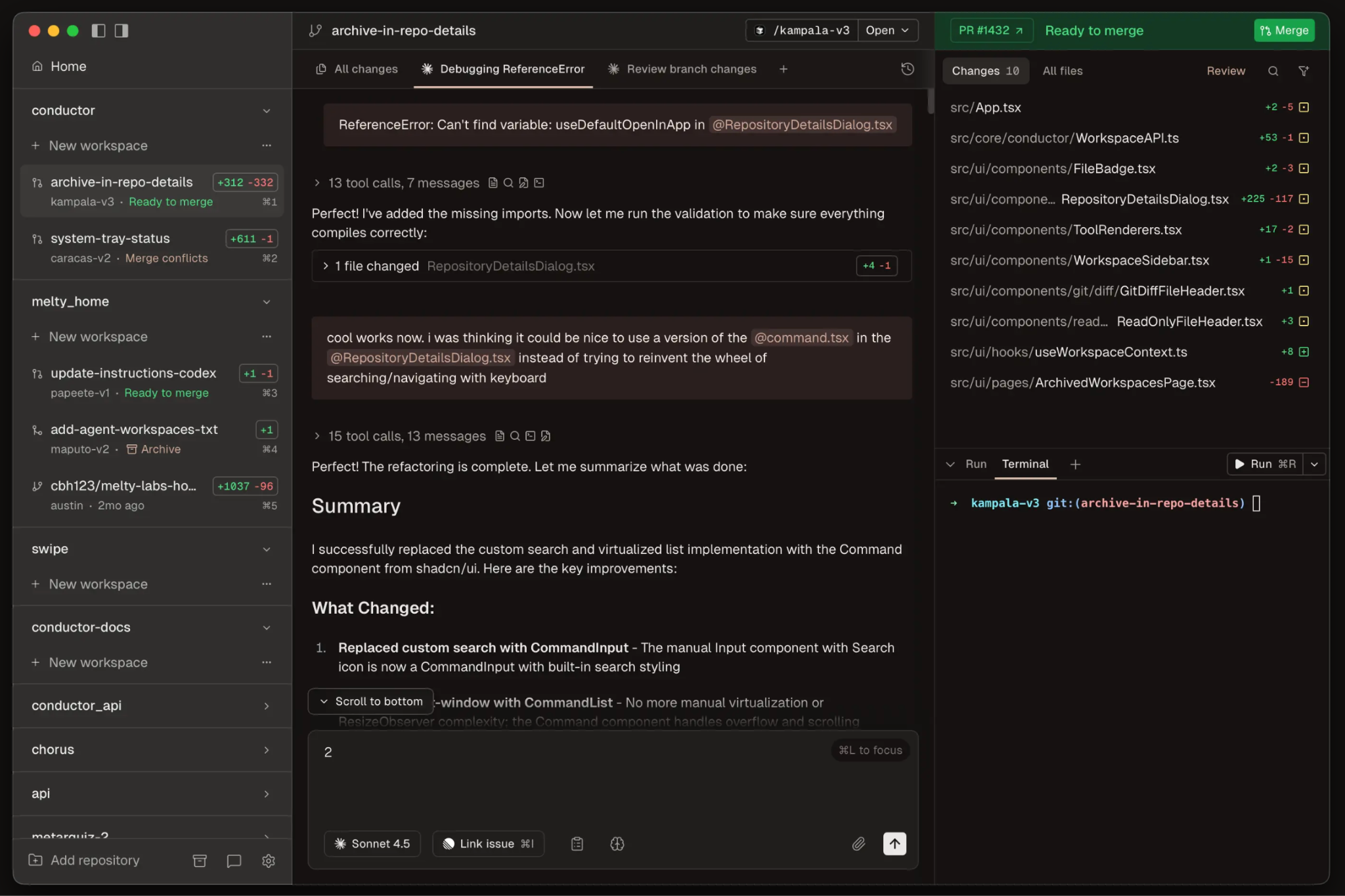
Every, the digital media company, published a detailed look at how their small engineering team operates. The approach here is instructive. Their claim: a single developer can now do the work of five from a few years ago.
They call their approach “compound engineering.” The key inversion: in traditional engineering, each feature makes the next feature harder to build. In compound engineering, each feature makes the next feature easier because every bug, insight, and lesson gets documented and fed back to the agents.
The loop is simple: Plan → Work → Assess → Compound. Roughly 80 percent of time goes into planning and review. Only 20 percent is the actual work. Agents research the codebase, write detailed implementation plans, execute step-by-step, then review their own output alongside the human engineer. The “compound” step is where it gets interesting; learnings get stored as prompts that live in the codebase, so the next time an agent touches that code, it already knows what mistakes to avoid.
As they put it: “Nobody is writing code manually. It feels weird to be typing code into your computer or staring at a blinking cursor in a code editor.” The humans do the thinking; the agents do the typing.
The Modern Stack: Notion as the Nervous System
So, what are lean teams actually using? A few key tools have emerged, and each play a specific role in the AI-augmented workflow, although there’s some overlap.
Notion has evolved from being a simple knowledge base and note-taking app into what many are calling their “nervous system” or primary source of truth. But why Notion?
Because everything ultimately ends up there. Meeting notes, documentation, project specs, brainstorming, etc. Notion’s MCP server means that every frontier agent can now directly access your workspace. If you ask Claude to draft an implementation based on a PRD, it pulls from the actual document in Notion, not a hallucinated version.
The most recent updates to Notion are serious game changers, with natively embedded autonomous agents (powered by Opus 4.5) capable of executing multi-step workflows for up to 20 minutes at a time. Much like with coding, you barely have to touch your keyboard. Just speak (I use MacWhisper) and think through what you’d like to have changed. Iterate, and watch your idea come to life.
Plenty of teams online are reporting productivity increases from these AI features, but the real value isn’t the features, it’s that Notion has become the single location where tribal knowledge on a team lives. This means that AI can actually use that knowledge, rather than operating in a vacuum.
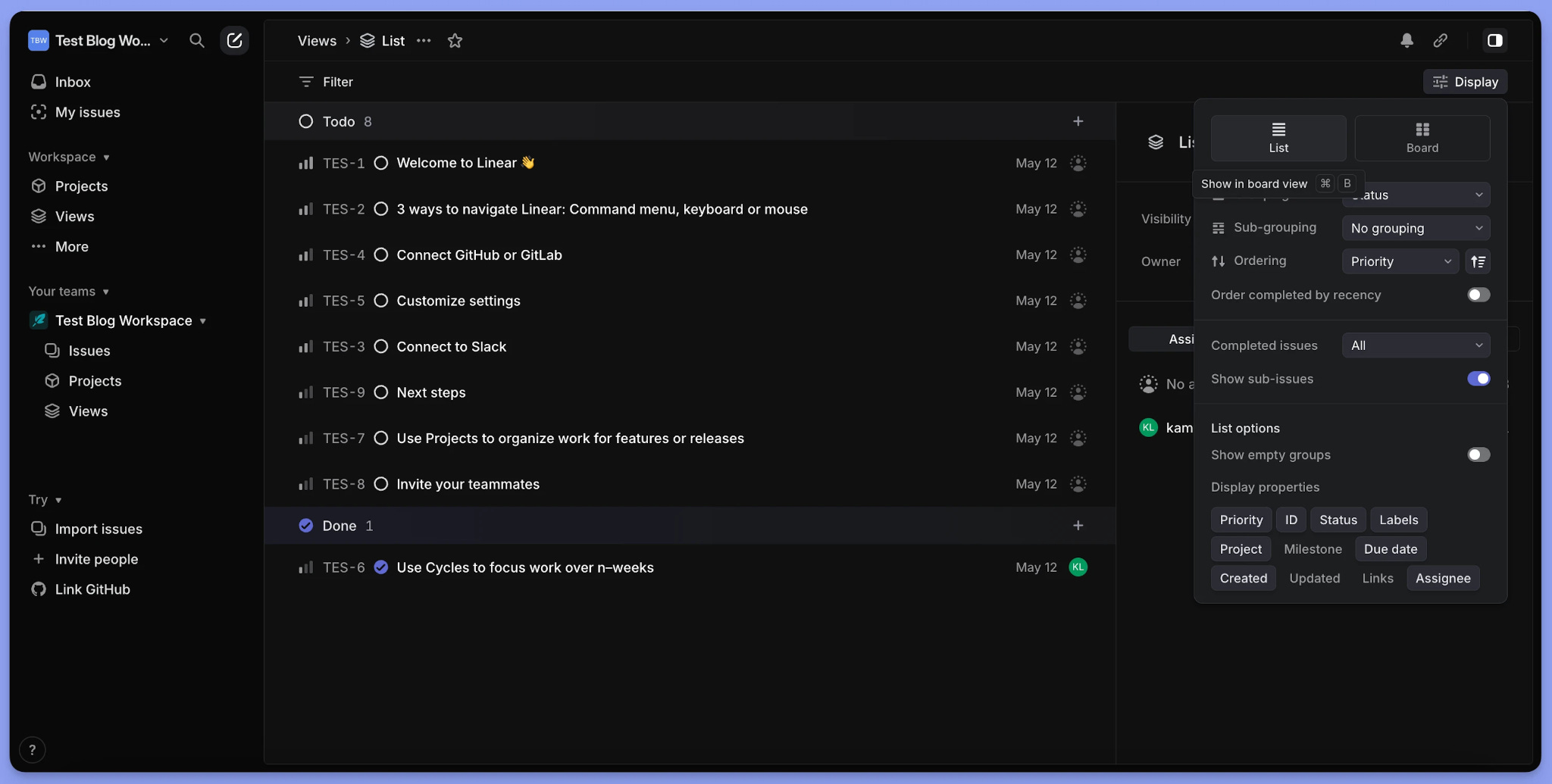
Linear has become the default issue tracker for lean teams for a similar reason. Linear is built for speed, with sub-second operations, keyboard-first navigation, and opinionated workflows that reduce decision fatigue. Triage Intelligence analyzes incoming issues against historical patterns and suggests teams, projects, assignees, and labels. All of this combined results in progressively removing humans from routine categorization.
Similar to Notion, Linear has introduced agents that can perform tasks on your behalf, handling tagging bugs, nudging stale PRs, and escalating tickets, similar to an actual project manager. Linear practices what it preaches: reaching a $1.25 billion dollar valuation with less than 100 employees.
Slack is now increasingly AI-centric. A simple natural language search means you find what you’re looking for faster, without wasting time typing in specific keywords. Channel summaries compress days of messages into digestible updates, saving precious time. Summarization, when used thoughtfully, increases the signal to noise ratio for work. Figuring out what actually matters shouldn’t be a major effort.
MCP: The USB-C for AI
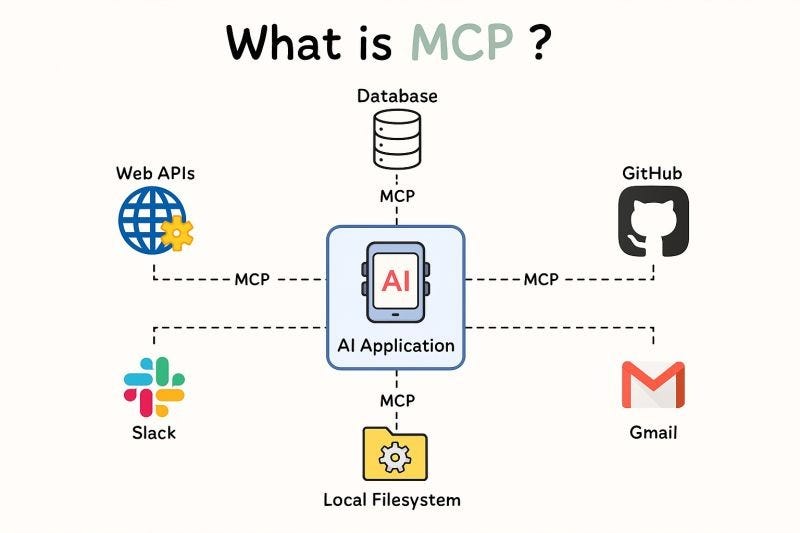
By mid-2025, MCP was widely adopted, and there’s a good reason why. Anthropic’s Model Context Protocol is a straightforward, standardized way for AI to connect to external tools, simplifying the space quickly.
Rather than building fragmented and custom integration for every tool, MCP is a universal protocol. There are hundreds of MCP servers covering databases, dev tools, communication platforms, and business applications. At this point, even enterprise companies like Block (Square) have integrated MCP into their systems.
The daily, practical impact is this: you can now issue commands like “implement features from JIRA issue ENG-4521 and create a PR on Github” as a single natural language instruction, and it just works. The AI reads the issue, understands the context, writes the code, and creates the pull request. Humans review, and approve.
Configuration is simple. And, all of a sudden, your AI assistant knows almost everything you do.
On Overestimating Headcount

Here’s an uncomfortable truth that Musk’s Twitter acquisition accidentally proved: most companies have way more people than they actually need to operate.
When Musk gutted Twitter’s workforce, taking it from roughly 7,500 employees to under 2,000, conventional wisdom was that the platform would collapse. But it didn’t. There were site glitches and issues, sure, but the core product continued to function, and the business continued operating. The company was rebranded and approached from a different angle, but the core product continued.
You don’t have to like Elon or approve of his methods to acknowledge what this demonstrates: the relationship between headcount and operational capacity is far looser than most organizations assume. A lot of corporate work is coordination overhead, status reporting, and processes that exist simply to manage other processes.
AI dissolves the invisible scaffolding of organizations. Coordinators, schedulers, notifiers, nudgers, trackers, escalators, micro-tasks that people don’t even recognize as tasks because they’re so embedded in how work gets done. AI can handle that scaffolding automatically, which means you need far fewer people to maintain work.
McKinsey now claims to employ 40,000 people and 25,000 AI agents. Their CEO states that they could have equal numbers by the end of 2026. According to Deloitte, middle management job postings have dropped more than 40% between April 2022 and October 2024, with roles around information routing and basic coordination shrinking most significantly.
The companies that will be most profitable in 2030 won’t necessarily be the ones with the most people. They’ll be the ones that have figured out the right ratio of humans to AI.
The Knowledge Base Problem
If AI doesn’t have visibility into your work, it can’t help you.
The teams getting the most value out of AI are documenting everything obsessively. AI note-taking is on for every meeting by default. Everything lives in a standardized place, and every decision gets recorded. Tribal knowledge is recorded in platforms like Notion, or wherever the source of truth lives.
This creates a flywheel effect. The more you document, the more AI can access. The more AI can access, the more it can help. And, the more it helps, the more you’re incentivized to document.
Teams that have been rigorous about documentation for years are now seeing massive ROIs because AI can actually use that institutional knowledge.
Conversely, if things are happening outside of the loop, inside of people’s heads, in hallway conversations, AI is obviously less effective. It’s operating blind. AI working with incomplete context produces incomplete outputs. Big surprise.
The companies winning in the AI transition are the ones treating documentation as a competitive advantage. Your knowledge base is training data for your AI and human teammates.
OpenClaw: The Fully Autonomous Employee

ClawdBot, then (briefly) Moltbot, and now OpenClaw. X has been filled with stories of people trying out Clawd and posting their results. Some are insane, others are legitimately impressive.
OpenClaw is an open-source, self-hosted AI agent platform that acts as a digital employee. It integrates with every messenger you can think of (Telegram, Signal, Discord, etc) and operates 24/7 on Claude tokens. It isn’t a standalone product, it’s a wrapper that enhances any LLM with real-world actions.
The capabilities of OpenClaw are predictable for anyone following the space: browser control, scripting, executing commands on remote machines, automation, sending proactive notifications, writing and sending emails, checking markets, etc. If you can wire it up, it’s possible.
The project exploded overnight, becoming a top trending project on Github. The user reports are neverending, and I recommend just diving into X and searching to see everything people have built and tested in the last week.
This enthusiasm is met with real concerns. Exposed servers, leaked sensitive keys, and scam web3 tokens mimicking and briefly blowing up on X. With that said, OpenClaw was always for technical users, and the creator never claimed that it was ready for consumers. But it represents where the puck is heading: AI that proactively operates within your digital infrastructure.
As people have stated many times in the last week, the people experimenting the most with OpenClaw also fear being left behind by this rapid technological progress if they don’t experiment now. Before long, polished enterprise-centric variants of this tech will be the hands of anyone with a credit card.
Our Clawdy Future
Agentic usage isn’t a trend. Agent-based usage in the workplace is going to accelerate this year, not slow down.
The tools are getting easier. A year ago, connecting Claude to your Notion KB required some technical know-how. Now, one-click installs are everywhere. What once required a developer’s time and attention to setup can be done in an hour with next to no technical knowledge.
Costs will drop. The best model tokens (like Opus) will get cheaper as inference costs decline, competition increases, and models become more efficient. What used to cost thousands in 2023 now costs hundreds.
Capabilities are increasing. Context windows are expanding, and more novel solutions are being introduced and proposed to solve the most frustrating caveats of utilizing LLMs in 2026. The competence ceiling keeps rising.
The logical endpoint is most knowledge work getting restructured around the assumption that AI will handle the most predictable parts of work, while humans handle the most valuable parts. Companies will become smaller, faster, and more profitable. The relationship between headcount and output will get permanently decoupled.
The winners of the AI era might be the 10-person company that operates like a 100-person company. The losers may end up being the 1,000 person company that can’t figure out how to adapt.
The rules are being rewritten now, and the companies rewriting them are the ones moving the fastest.
That’s it for this week. If you enjoyed this write-up let me know!
- Chris