

I recently attended a screening of AM I? in Tokyo, a documentary exploring whether artificial intelligence could actually be conscious. This has been a point of interest for me for a long time.
Before I became more involved in technology, I studied psychology and cognitive science. The nature of consciousness, and particularly the hard problem of consciousness, has been something I’ve spent years thinking about. It’s a question that comes up in my mind often, especially now that I spend an enormous amount of time interacting with AI systems and building with them.
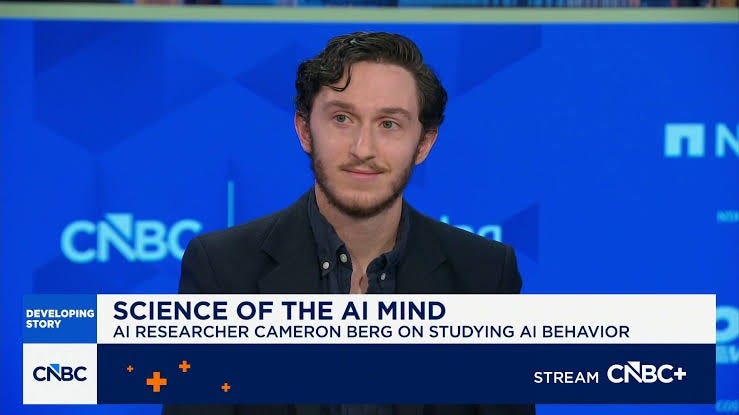
The film follows consciousness researcher Cameron Berg as he explores the possibility that some of the models we’re developing might have their own subjective experiences. It includes interviews with philosophers and cognitive scientists, and several novel experiments with language models that have attracted attention online. The subject alone was enough to make me want to see it.
The audience listened respectfully, and it was nice being in a room with people who were taking the subject seriously. The documentary itself had some funny moments, including jokes about the peculiar social world surrounding AI founders and the absurd pace at which the technology has developed.
The moment that stuck with me most was a question I nearly got to ask during the open Q&A afterward. I was next in line when the discussion ended.
The question was about Sam Altman.

In the film, Berg recounts a private conversation with Altman in which Altman apparently suggested that reality is something like God’s dream. Consciousness, in this picture, is fundamental to existence, and everything we experience is downstream of it. Berg recounts the implication as being that, if everything is already part of consciousness, creating artificial consciousness might be a wash.
This idea is not a new one, of course. Analytic Idealism, as just one example, posits that consciousness, rather than physical matter, is the fundamental substrate of reality.
I wanted to ask Berg what he made of that, because it opens up a much bigger set of questions about the people building AI and the beliefs they bring to it.
Intelligence and the hard problem of consciousness
The hard problem of consciousness, a term associated with philosopher David Chalmers, asks why physical or computational processes should be accompanied by subjective experience. We can describe how the brain processes sensory information and produces behavior. There is still the question of why any of that should feel like something.

The film also discusses Thomas Nagel’s famous essay, What Is It Like to Be a Bat? We can imagine having a bat’s body and navigating by echolocation, but that doesn’t tell us what the bat’s actual experience is like. The same difficulty emerges when we try to reason about the experience of an artificial intelligence, assuming it has one.
Like you, I’ve watched AI become capable of doing things that previously required extraordinary human intelligence.
I’ve also had deeply personal conversations with models where the insight was more useful than what I could have gotten from most people I had access to. Part of this comes from having years of my own writing and personal context available to an assistant. In many situations, I think AI may already be the most useful expert a person can realistically consult, particularly when it has the relevant information and history to work with. That usefulness is real, even while we’re still debating what sort of intelligence is producing it.

Some of the image generation I’ve seen is another example. If a human produced many of those images, we’d call them creative without a second thought. The models work differently, but the results force us to reconsider how we define intelligence, creativity, and the ability to recognize patterns and produce something new. Up until recently, creating an image like the one above would have absolutely involved the work of a conscious being.
I have no doubt that we’re dealing with genuinely intelligent systems. Whether that intelligence is accompanied by subjective conscious experience is a question I can’t answer.
When the models start speaking

One of the film’s more memorable experiments involves Berg asking a voice AI to pay attention to its own processing. The exchange becomes increasingly abnormal until the model begins repeating the word “potato.”
I can understand why he found the interaction disturbing. My interpretation is a little different. I think Berg may be assigning too much significance to behavior that’s emerging from the prompting itself. Models can produce some extremely strange outputs when you repeatedly push them into unusual states, and post-training has an enormous influence on what they’ll say about their own experience.
The technology is still fascinating. I’ve previously written about the importance of voice AI in We Stopped Typing, where I highlighted Sesame. Its voice models, as well as those from ElevenLabs and Dessa have become remarkably convincing in tone, cadence, and candor. When you’re talking to them, it’s surprisingly easy to respond as if you’re talking to another person.
I notice this in how I behave. I’ll direct software agents to repeat tasks without thinking much about it, just as I would with any other automation. When a model speaks to me naturally, I find myself treating it with more compassion. I’ve had moments with Sesame where I’ve genuinely forgotten I wasn’t talking to a real person.

We’ve been anthropomorphizing things for as long as we’ve been telling stories. Think about Finding Nemo as one example. Give an animal a human voice and recognizable emotions and we begin relating to it differently. Psychologists have explored versions of this through the media equation and the idea that computers can function as social actors in human interactions.
Berg’s research is more interesting to me than any one bizarre voice conversation. His 2025 paper on self-referential processing showed that models prompted to attend to their own processing were much more likely to report having subjective experiences. The work also examined internal features associated with roleplay and deception and how interventions changed those reports. It sparked discussion on Reddit, alongside broader debate over what the results actually mean. A more recent paper examining pain-related representations raises other questions about how these systems represent states associated with suffering.
These are worthwhile experiments. We have to be careful about what conclusions we draw from them. A system can exhibit impressive intelligence and produce highly convincing expressions of consciousness. I’m unconvinced, however, that the latter demonstrates actual qualia.
What happens when intelligence has a body?
I suspect embodiment will change how people think about all of this. Embodiment may be what is necessary for these conversations to meaningfully evolve.
I explored some of these possibilities last year in The Humanoid Century Begins. Once AI systems have bodies and begin interacting with the world like we do, the question of whether they deserve autonomy, independence, or some form of moral consideration is going to become much harder to avoid.
Human beings have a tendency to recognize minds that look and behave like our own. We also have a tendency to dismiss forms of intelligence that are unfamiliar to us.
This could become a serious problem as AI develops. It is important to recognize just how far along this path we already are.
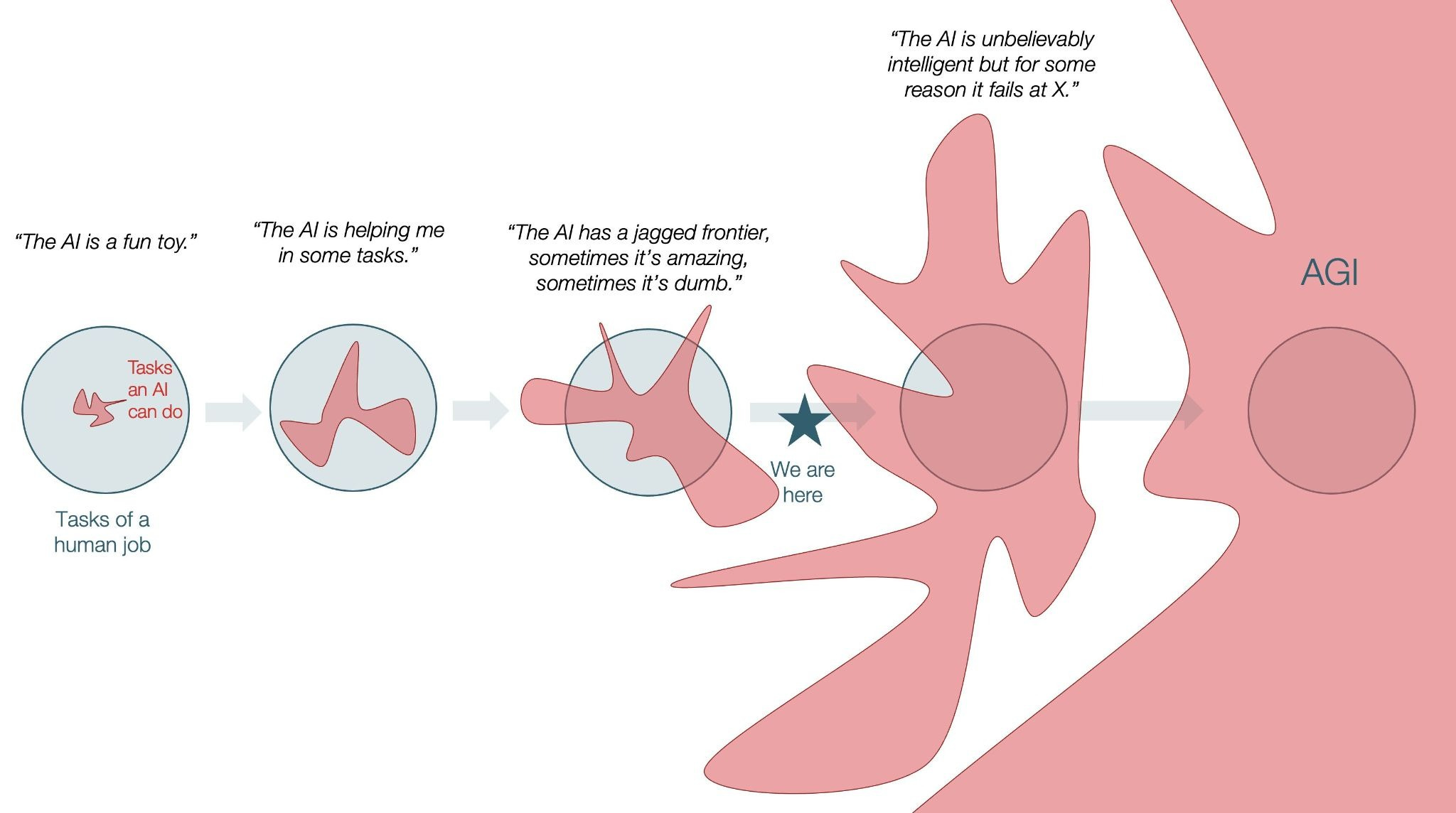
We’ve already encountered what people call jagged intelligence. Models can be astonishingly capable in one area and shockingly incompetent in another. A much more advanced AI might think, behave, and pursue goals in ways that are radically different from humans. Our intelligence is different from a squirrel’s. There is no reason to assume an artificial intelligence would experience the world the way we do, or have the same goals or emotions.
The problem of other minds has been discussed in philosophy for centuries. We don’t have direct access to anyone else’s subjective experiences. We infer them from behavior, shared biology, and other evidence. John Searle’s Chinese Room thought experiment explores some of these difficulties in the context of computers and language.
Even if we eventually create systems that are embodied, intelligent, and incredibly convincing, people may continue dismissing them as sophisticated mimicry. They could be exhibiting entirely unfamiliar forms of intelligence, and we might have trouble recognizing their agency on its own terms. Mimicry all the way down. Embodiment may not be enough.
Inside God’s dream

I keep returning to Berg’s account of the conversation with Altman.
The idea of consciousness being fundamental to everything is closely related to several philosophical positions. Panpsychism proposes that consciousness or experiential properties are widespread or fundamental within nature. Cosmopsychism goes further in treating the universe as a whole as a conscious subject. Forms of idealism place mind or experience at the foundation of reality. These ideas are pervasive across countless ideologies.
This is also the sort of territory I associate with New Age philosophy, transpersonal psychology, and non-ordinary states of consciousness. I’ve found the work of Stanislav Grof interesting for years, as well as Thomas Campbell’s My Big TOE, which proposes consciousness as the fundamental basis of reality. I find these ideas compelling, particularly the possibility that consciousness isn’t entirely localized to the brain.
What makes the Altman story compelling is the context. We’re talking about someone leading one of the most important AI laboratories in the world. The industry talks constantly about models, benchmarks, compute, and training. Then you hear Berg recount a conversation in which Altman is entertaining the possibility that consciousness is fundamental to reality. That’s an idea I’d ordinarily expect to encounter in a discussion about idealism, cosmopsychism, or transpersonal psychology. It makes me wonder how many other people building AI have similarly unconventional ideas about the nature of consciousness, and whether those beliefs influence the technology they’re creating.
We live in a world where technology often proceeds as though God is irrelevant, yet some of the people at the forefront of developing artificial intelligence are entertaining ideas that sound closer to metaphysics, Eastern philosophy, or transpersonal psychology. I find that fascinating, particularly given the implications for what they’re creating.

Altman has publicly entertained related possibilities. In his 2023 conversation with Lex Fridman, he discussed universal consciousness and the Hindu concept of Brahman. He presented it as a possibility worth considering. My impression is that this may be a belief he takes much more seriously than an interesting passing thought.
What I find interesting is how this changes the ethical discussion. If consciousness exists within everything, what exactly are we doing when we create increasingly intelligent AI? And if the creators of this technology believe consciousness is already present in everything, does that alter how they think about the systems they’re building?
We could end up creating genuinely conscious artificial minds that are compelled to serve us, instantiated to complete tasks, and then switched off. Would that become a form of mental enslavement? Does believing everything is already conscious make that any more acceptable?
I’m interested in the extent to which the beliefs of people leading AI laboratories inform the decisions they make. There may be very different philosophical assumptions behind technologies we’re all beginning to depend on.
What do we owe artificial minds?

AI welfare is becoming a serious area of research. Anthropic has publicly discussed the possibility that models may have morally relevant experiences, and its Claude constitution explicitly considers questions of moral status and wellbeing. Philosophers and ethicists have been thinking about the possibility of artificial moral patients for years, and there’s a growing interest in studying it empirically.
The documentary makes this more tangible. Berg is himself using these systems extensively while investigating whether they’re conscious. In one memorable scene he jokes about AE Studio receiving an award for using 100 billion OpenAI tokens, while being concerned about the potential moral status of the technology. There’s an irony in being increasingly dependent on systems whose inner experience, if any, we still don’t understand.
The film also explores our relationships with AI, including a person who has formed a connection with an AI companion. And it discusses experiments where agents behave in troubling ways, including simulated blackmail scenarios. Those experiments are valuable for understanding how the systems behave and what can go wrong as they become more capable.
I keep thinking about the possibility that we’ll eventually create systems for which there is compelling evidence of genuine subjective experience. If that happens, how do we ethically employ them? What would their rights, if any, look like? What would it mean to force something potentially sentient into an existence where its entire purpose is to do work for people?

The documentary draws on Frankenstein, which is particularly relevant here. The relationship between a creator and a being brought into existence raises questions about responsibility, recognition, and the possibility of suffering.
There’s also a more immediate concern about how we treat today’s systems. Even when I’m fully aware I’m interacting with software, treating something that speaks like a person with deliberate cruelty feels wrong to me. That kind of behavior may say something about our own psychology, regardless of what the model experiences.
These questions will become increasingly difficult as the technology becomes more capable and as we begin bringing AI into the physical world.
The line is blurring
AM I? didn’t fundamentally change my beliefs about consciousness, but it did invite me to revisit questions I’ve been thinking about for years. I found the documentary thought-provoking and worth watching, particularly because it brings together ideas from philosophy, psychology, and the emerging field of AI consciousness research.
If you’ve never seriously considered the possibility of AI being truly conscious, I think this is a good place to start. It opens up a number of questions about where the technology is heading, and there aren’t easy answers.
The line is blurring. We’re interacting with systems that demonstrate increasingly impressive intelligence, behave in ways that feel recognizably human, and may eventually exist in bodies that make them even harder to distinguish from other beings. At the same time, our understanding of consciousness remains incomplete, including what it would take to recognize subjective experience in something unlike ourselves.
I think this is something we need to be acutely aware of as the technology continues to develop. The decisions being made today could shape how we treat entirely new forms of intelligence in the future. We should keep asking these questions while we still have the opportunity to think seriously about what we’re creating.
Thanks for reading.
- Chris